
The Tech Neck Problem: How to Fix Forward Head Posture
In This Guide
- Why your head feels heavier the more you look down
- The muscle imbalance pattern behind tech neck
- Six exercises to reverse forward head posture, step by step
- Desk and phone habits that take the strain off your neck
- When home care is not enough, and how our team can help
Start Here: The Short Version
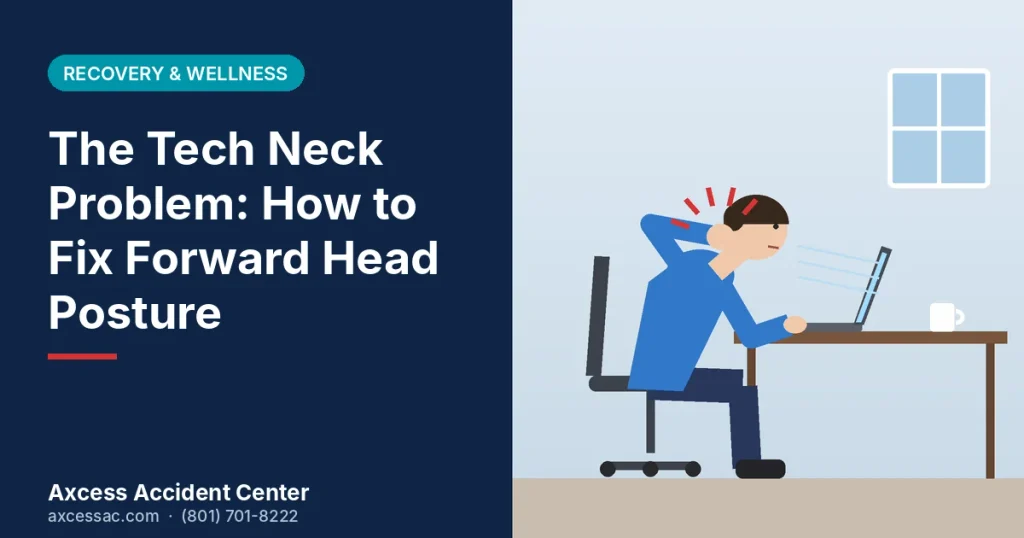
Tech neck is the strain that builds when you spend hours looking down at a phone, tablet or laptop. Over time your head drifts forward, your shoulders round and the muscles in your neck and upper back stay overworked. The fix has three parts: stretch the muscles that have tightened, strengthen the ones that have weakened, and change the desk and phone habits that caused the problem. If pain spreads into your arms, comes with numbness or started after a car accident, get evaluated.
The 10-Pound Problem: Why Your Head Feels Heavier
The average adult head weighs about 10 to 12 pounds. When your head sits balanced over your shoulders, your neck muscles barely have to work to hold it up. As your head tips forward to look at a screen, those muscles have to work much harder to keep it from dropping, and the further forward it drifts, the greater the load. Hold that position for hours a day and the result is muscle fatigue, stiffness, headaches and a habit your body defaults to even when you put the phone down.
Pro-Tip: Screen height matters more than almost anything else at your desk. Bring the screen up to your eyes instead of bringing your eyes down to the screen.
Why Tech Neck Develops: The “X” Pattern
Long hours of slouching create a predictable pattern of muscle imbalances, often called Upper Crossed Syndrome. Picture an X across your upper body:
- Tight and overworked: the chest muscles (pectoralis major and minor) in front, and the upper trapezius and levator scapulae at the back of the neck
- Weak and underworked: the deep neck flexors in the front of the neck, and the middle and lower trapezius, rhomboids and serratus anterior in the mid-back
Correcting tech neck means working both sides of that X: lengthen what is tight and strengthen what is weak.
Six Exercises to Reverse Forward Head Posture
Warm up first with a few minutes of walking, gentle shoulder rolls or a warm shower. Move slowly and stop if any exercise causes sharp pain, numbness or tingling.
1. Chin Tucks (Deep Neck Flexors)
- How: Sit or stand tall with your gaze level. Gently glide your chin straight back, as if making a double chin.
- Cue: Keep your eyes level. Do not tip your head down.
- Dose: Hold 2 to 5 seconds and release slowly. Do 2 to 3 sets of 12 to 15 reps daily.
Key Distinction: If your eyes drift toward the floor, you are nodding, not tucking. A true chin tuck moves your head straight back over your shoulders.
2. Doorway Chest Stretch (Pectorals)
- How: Place your forearms on a doorframe with elbows bent to 90 degrees. Step forward with one foot until you feel a gentle stretch across your chest.
- Cue: Keep your back straight and ribs relaxed. Do not arch or twist.
- Dose: Hold 20 to 30 seconds while breathing normally. Repeat 2 to 3 times, two or three times a day.
3. Shoulder Blade Squeezes (Rhomboids and Mid-Trapezius)
- How: Sit or stand with arms at your sides. Squeeze your shoulder blades together as if holding a pencil between them.
- Cue: Keep your shoulders down, away from your ears.
- Dose: Hold 5 seconds. Repeat 10 times daily.
4. Wall Angels (Scapular Control)
- How: Stand with your hips, upper back and head against a wall, arms in a goalpost shape. Slowly slide your arms up and back down.
- Cue: Do not flare your ribs or force the range. If your wrists or elbows lift off the wall, shorten the movement.
- Dose: 2 to 3 sets of 10 to 12 reps daily.
5. Prone Y-T-W Raises (Mid-Back Stabilizers)
- How: Lie face down with your forehead supported. Raise your arms into a Y, lower; then a T, lower; then bend your elbows into a W while drawing your shoulder blades down and back.
- Cue: Keep your neck relaxed and lift from your upper back, not your shoulders.
- Dose: 2 to 3 sets of 12 to 15 reps per position, three days a week. Start with no weights.
Each shape works a different part of the upper back:
- Y: lower trapezius, which draws the shoulder blades down
- T: rhomboids and middle trapezius, which pull the shoulder blades together
- W: the rotator cuff’s external rotators, which steady the shoulder
6. Dead Bugs (Core and Spinal Control)
- How: Lie on your back with hips and knees bent to 90 degrees and arms raised. Brace your abs, then slowly lower the opposite arm and leg toward the floor, taking 3 to 5 seconds.
- Cue: Your lower back should stay in contact with the floor. If it arches, make the movement smaller.
- Dose: 2 to 3 sets of 10 to 15 reps, five days a week.
Pro-Tip: Good posture is not a pose you hold; it is a skill you practice. Quality beats range on every exercise.
A Simple Weekly Routine
- Every day: Chin Tucks, Shoulder Blade Squeezes and the Doorway Stretch
- Monday, Wednesday, Friday: add Dead Bugs and Prone Y-T-W Raises
- Tuesday, Thursday: add Wall Angels
- Saturday: add Dead Bugs
- Sunday: active recovery, such as a 20 to 30 minute walk or swim, plus a wall posture check
Check off each habit at the end of the day. On Sunday, look at what you missed and adjust your reminders or desk setup for the week ahead.
Fix Your Desk and Phone Habits
Exercises work best when you also remove the strain that caused the problem.
- Raise your screen. Set the top of your monitor at or slightly below eye level, about an arm’s length away.
- Elevate your laptop. Use a stand with an external keyboard and mouse so your elbows rest at about 90 degrees.
- Support your lower back. Use a chair with lumbar support, or add a small cushion or rolled towel.
- Follow the 20-20-20 rule. Every 20 minutes, look at something 20 feet away for 20 seconds. It rests your eyes and gets your neck moving.
- Take a movement break every hour. Stand, walk and stretch for a few minutes.
- Go hands-free. Use a headset for long calls and voice commands to cut down on looking down at your phone.
- Lift your phone. Hold it closer to eye level instead of dropping your chin to read it.
When Home Care Is Not Enough
Home exercises are a great maintenance tool, but some cases need hands-on care. At Axcess Accident Center, a plan may include:
- Chiropractic adjustments to restore normal joint motion in the neck and upper back
- Massage therapy to relax tight, guarded muscles. Many patients find a short massage before an adjustment makes it more comfortable, and soft-tissue work afterward helps with soreness.
- PostureRay analysis to measure your posture and track your progress
- Spinal decompression when disc-related pain keeps you from moving well enough to exercise
- Rehabilitation exercises tailored to your body, not a generic routine
Red Flags: Get Evaluated If You Notice
- New or worsening neck pain after a car accident
- Pain, numbness or tingling that travels into your arms or hands
- Unexplained weakness in your arms or grip
- Headaches that are severe, new or getting worse
- Pain that keeps you from sleeping, working or doing daily tasks
Frequently Asked Questions
Can tech neck be reversed?
In many cases, yes. Stretching tight muscles, strengthening weak ones and changing your desk and phone habits can improve forward head posture over time. Consistency matters more than intensity.How long does it take to fix forward head posture?
It varies with how long the habit has been in place and how consistent you are. Many people notice less stiffness within a few weeks of daily exercise and better ergonomics. Lasting posture change takes longer.Is a “neck hump” caused by tech neck?
Rounding of the upper back that develops with long hours of slouching can contribute to the look of a hump at the base of the neck. A chiropractor can assess what is causing it and whether exercise and care can help.Can a chiropractor help with tech neck?
Yes. Chiropractic adjustments, massage and posture-focused rehab can relieve pain and restore motion, while home exercises and ergonomic changes keep the improvements going.Does a car accident make tech neck worse?
It can. Whiplash strains the same neck muscles and joints that tech neck already overworks. If your neck pain started or got worse after a crash, get evaluated by an auto injury provider.
Ready to Fix Your Posture?
Our team in Provo, Spanish Fork, American Fork and West Valley City can assess your posture, relieve your pain and build a plan to keep tech neck from coming back.